Seven Instruments Reshaping How American Facilities Read Their Environment
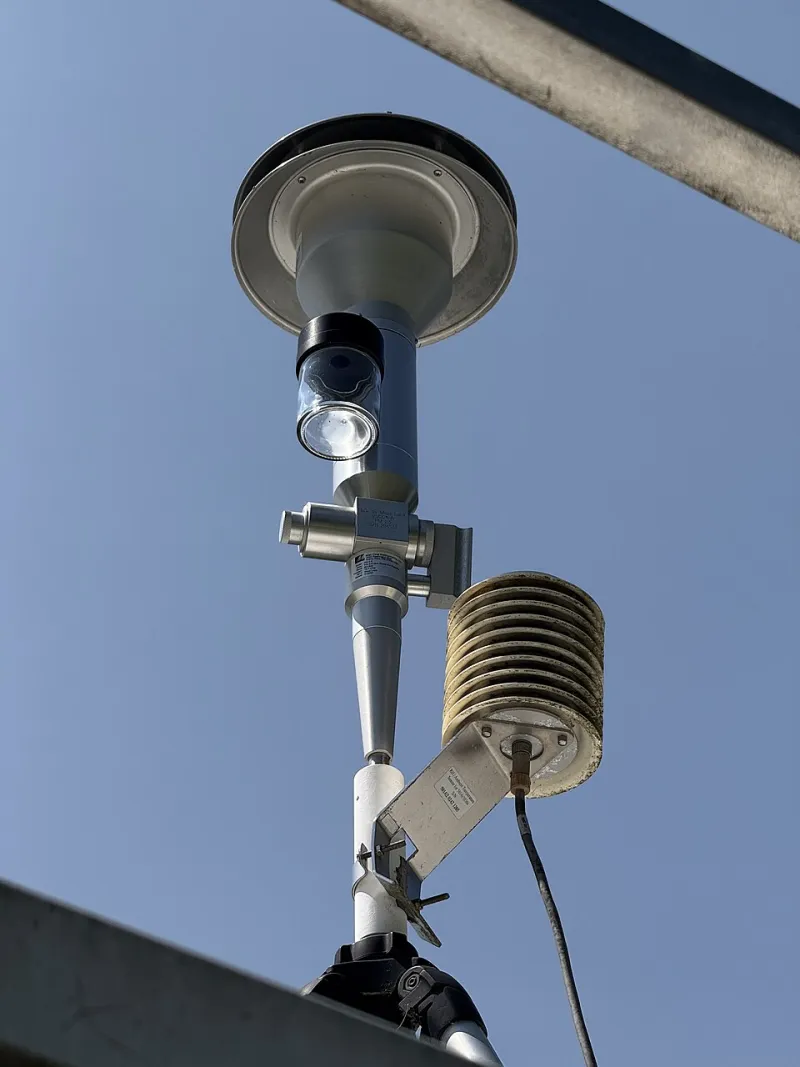
Photo: Famartin, CC BY-SA 4.0, via Wikimedia Commons
The environmental monitoring market in the United States has shifted decisively from bespoke, research-only instrumentation toward accessible, deployable technology. A water treatment operator in Ohio and an air quality researcher in California can now draw from overlapping toolkits — and increasingly, overlapping budgets. Below, we examine seven sensor categories defining facility-scale environmental sensing in 2025, with practical notes on pricing and fit.
1. Low-Cost Particulate Matter Monitors
Optical PM2.5 sensors — the technology behind consumer air quality displays — have found serious work in industrial settings. Units in the $200 to $600 range, such as those built on laser-scattering principles, allow facilities near highways, rail yards, or construction zones to build dense monitoring grids that would have been prohibitively expensive a decade ago.
A community college in Denver, for example, might deploy a dozen units across campus buildings to correlate indoor air quality with wildfire smoke events. The caveat: optical sensors struggle to distinguish particle types, so they complement rather than replace regulatory-grade reference instruments.
2. Multiparameter Water Sondes
The workhorse of modern water quality programs. These cylindrical instruments, typically $5,000 to $25,000 depending on configuration, bundle sensors for dissolved oxygen, pH, conductivity, turbidity, and temperature into a single deployable package.
Municipal utilities across the Mississippi watershed use sondes for continuous reservoir profiling, while aquaculture operations in the Southeast rely on them for real-time oxygen management. When evaluating sondes, prioritize anti-fouling wipers and battery endurance — field conditions, not lab specs, determine real performance.
3. Electrochemical Gas Sensors for Industrial Safety
For facilities handling refrigerants, chlorine, or combustion byproducts, electrochemical gas sensors remain the standard. Priced from a few hundred dollars per sensing element, they offer selectivity for specific target gases.
Cold storage warehouses using ammonia refrigeration — common across the Midwest food processing corridor — depend on fixed-point detection networks governed by OSHA and IIAR standards. Replacement schedules matter here; electrochemical cells degrade on predictable timelines regardless of use.
4. Soil Moisture and Vadose Zone Probes
Agricultural operations and landfills alike benefit from capacitance and time-domain reflectometry (TDR) soil sensors, generally $100 to $2,500 per point. California almond growers use networks of these probes to schedule irrigation against water allocation limits, while landfill operators track leachate movement through cover systems.
Match probe depth and measurement volume to your soil profile — a sensor calibrated for sandy loam will mislead in dense clay.
5. Photoionization Detectors (PIDs) for VOC Screening
Facilities managing remediation sites or underground storage tanks rely on PIDs, typically $1,500 to $6,000, to screen for volatile organic compounds. Environmental consulting firms across the Rust Belt deploy handheld and fixed PIDs during brownfield assessments, where petroleum legacy contamination is common.
Lamp energy (usually 10.6 eV) determines which compounds register, so spec sheets deserve careful reading before purchase.
6. Acoustic and Flow Sensors for Wastewater Networks
Combined sewer overflows remain a chronic challenge for older Eastern cities. Ultrasonic level sensors and area-velocity flow meters, ranging from $2,000 to $15,000 installed, give utilities visibility into stormwater surges before pipes are overwhelmed.
Philadelphia's Green City, Clean Waters program illustrates how dense flow sensing supports both regulatory compliance and infrastructure investment decisions.
7. Integrated Weather and Microclimate Stations
Complete meteorological stations — $1,000 to $20,000 depending on grade — anchor nearly every other sensing program. Evapotranspiration data guides irrigation; wind data informs fugitive emission modeling at industrial sites; solar radiation readings contextualize photochemical sensor behavior.
Facilities near airports or in exposed coastal zones should specify heated components and corrosion-resistant mounts.
Matching Specs to Mission
Three questions cut through marketing noise. First, what decision will the data support — compliance reporting demands different accuracy than trend monitoring. Second, what is the total cost of ownership, including calibration consumables and field service. Third, how will data integrate with existing SCADA or cloud platforms.
The most sophisticated sensor is worthless if its data never reaches a decision-maker. Choose instruments for the system they join, not the spec sheet they carry.