Listening as Instrumentation: The Microphone's Quiet Takeover of Environmental Monitoring
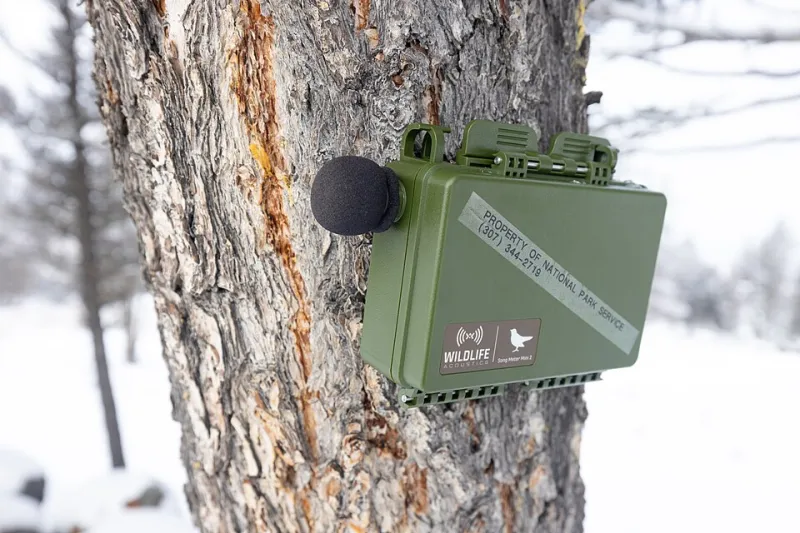
Photo: YellowstoneNPS, Public domain, via Wikimedia Commons
Environmental sensing is dominated by things we measure with chemistry: nitrate probes, gas chromatographs, particulate counters. But a growing contingent of researchers and companies argues that the most information-dense signal in many ecosystems isn't chemical at all. It's acoustic.
A weatherproof microphone costs a fraction of a multiparameter sonde. Paired with modern machine learning, it can distinguish a cerulean warbler from a red-eyed vireo, hear a pressurized water main cracking under a city street, and catch the whine of a chainsaw two ridges over from the nearest ranger station. For organizations evaluating their next monitoring investment, passive acoustic monitoring (PAM) deserves a closer look.
The Hardware Got Cheap; The Bottleneck Moved
The first generation of autonomous recording units — ARUs in industry parlance — were bespoke builds: consumer audio recorders in Pelican cases, cobbled together by graduate students with duct tape and hope. Today, commercial units from companies like Wildlife Acoustics and open-source designs like AudioMoth (developed by the UK-based Open Acoustic Devices consortium, but deployed extensively across US research programs) have pushed per-unit costs down to a few hundred dollars or less.
That price collapse matters less than what it changed operationally. When a sensor costs $2,000, you deploy ten. When it costs $100, you deploy a thousand — and suddenly the constraint isn't hardware, it's data.
"Nobody wants to listen to ten thousand hours of dawn chorus," as one bioacoustics consultant put it at a recent monitoring conference in Portland. The field's real work now lives in the classification layer: neural networks trained to pull target signals out of continuous recordings. Cornell's K. Lisa Yang Center for Conservation Bioacoustics, a hub of this work in the US, has spent years building the tagged libraries and open tools — Raven for visualization, BirdNET for automated identification — that make machine-assisted listening practical at scale.
Three Deployments Worth Knowing
Endangered species in the Appalachians. Detecting the presence of species like the declining golden-winged warbler or confirming activity patterns of the northern long-eared bat (whose monitoring is complicated by federal listing considerations) traditionally required human observers on foot. Acoustic grids now cover habitat corridors across multiple states, running continuously through breeding season. Detection rates that once depended on one biologist's ears now come from classifiers applied uniformly across thousands of sites — an audit trail regulators increasingly expect.
Water distribution networks. Municipal utilities from Tucson to Pittsburgh are experimenting with acoustic leak detection nodes that clamp onto hydrants and valves, listening for the characteristic frequency signature of water escaping a pressurized pipe. The EPA has estimated that hundreds of billions of gallons are lost annually in US distribution systems; acoustic sensing is one of the few technologies that finds those losses before they become sinkholes.
Forest protection in the Pacific Northwest. In watersheds where illegal timber harvest and unauthorized off-road activity are persistent problems, solar-powered acoustic sentinels listen for chainsaw signatures and vehicle noise, alerting land managers in near real time. The approach turns vast, thinly patrolled landscapes into monitored ones without a single new fence or camera.
What Sound Can't Do
A neutral assessment requires the caveats. Acoustic data is presence-absence data, not abundance data — a classifier that hears a species can't tell you how many individuals are present. Background noise from wind, traffic, and rain degrades detection rates in ways that vary by site and season. And model performance degrades silently: a classifier trained on one region's vocalizations may underperform badly when deployed across a mountain range, with no obvious error message to flag the problem.
This last point echoes a theme we've raised before about monitoring networks generally: instrumentation without validation is a slow-motion failure. Acoustic programs need the same calibration discipline — periodic ground-truthing by human listeners, model retraining cycles, documented uncertainty — that any other sensor fleet requires.
The Bet Being Placed
The commercial signal is growing. Startups are packaging acoustic analytics as subscription services for utilities and land trusts. Conservation NGOs are standardizing on shared hardware and shared models, building the kind of interoperable infrastructure that soil moisture and air quality networks took decades to achieve. Federal agencies, including USGS and the National Park Service, have expanded natural sound monitoring programs, treating acoustic conditions as a resource worth inventorying in their own right.
The argument, ultimately, is about coverage per dollar. No other environmental sensor modality offers this ratio of spatial reach to unit cost, and no other modality improves this fast on the analysis side, because it rides the same machine learning curve as the broader software industry.
For sensing professionals accustomed to chemistry and optics, the microphone can seem like an odd instrument — passive, omnidirectional, hostage to weather. But the deployments above suggest the question isn't whether acoustics belongs in a professional monitoring toolkit. It's which problems in your portfolio are, at bottom, listening problems — and whether you'd rather hear about them in real time or read about them in next year's report.