Three A.M. Conditions: The Hidden Test Your Sensors Never Signed Up For
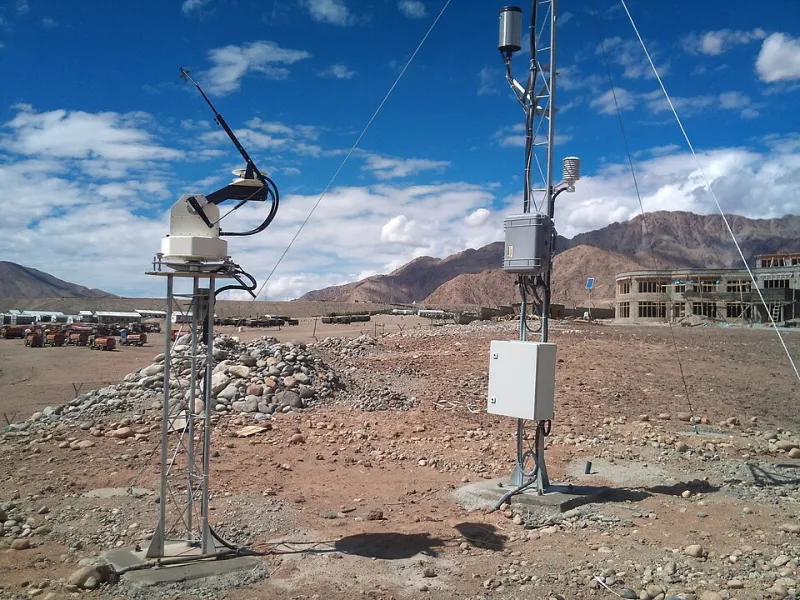
Photo: Fringe2013, CC BY-SA 3.0, via Wikimedia Commons
The monitoring station outside Lincoln, Nebraska looks unremarkable at dusk: a tripod, a radiation shield, a small enclosure humming on solar charge. By 10 p.m., the technician who services it has long gone home. But the most demanding hours of that instrument's working life are just beginning.
"People evaluate hardware at noon on a dry day," says a field technician who maintains air quality and micrometeorology sites across the Great Plains. "The instrument actually earns its reputation between midnight and sunrise. That's when the environment stops behaving politely."
When the Ground Breathes Out
Nocturnal boundary layers are the night shift's defining phenomenon. After sunset, the soil releases stored heat, the surface cools faster than the air above it, and a shallow inversion forms — sometimes only a few meters deep. Within that layer, humidity climbs, pollutants pool, and gradients become steep enough that two sensors separated by two meters can disagree by a wide margin.
For instruments, this is a stress test. Capacitive humidity elements saturated by dew can read far above ambient relative humidity or, worse, report plausible-looking numbers that are actually measuring the water film on the sensor itself. Optical particulate counters, calibrated against well-mixed daytime aerosol, encounter a stratified, moisture-laden atmosphere where hygroscopic particle growth inflates readings in ways the factory algorithm never anticipated.
"We had a PM site that looked like a smoke event every clear, calm night," the technician recalls. "It wasn't smoke. It was the inversion plus humidity correction that wasn't tuned for our climate. Daytime data was fine. The nighttime record was fiction."
Dew, Frost, and the Condensation Problem
Dew events are the quiet saboteur of unattended networks. A radiatively cooled sensor housing can drop below the dew point well before the surrounding air does, and condensation forms on exactly the surfaces you least want wet: lens optics, capacitive plates, thermistor junctions, connector pins.
Manufacturers know this, which is why aspirated radiation shields and heated inlets exist. But heated accessories draw power, and solar-powered sites in short-winter-day regions — the Pacific Northwest in December, the Upper Midwest in January — often can't sustain the duty cycle. Technicians describe triaging which sensors get heat tape and which are left to fend for themselves until sunrise.
The result is a diurnal bias pattern baked into the dataset: clean midday values, questionable dawn values, and no flag marking the difference. "You can spot an under-powered station from the data alone," one site manager says. "The humidity traces spike every morning at the same hour. That's not weather. That's a battery budget."
Thermal Cycling as a Slow Torture Test
Beyond any single night, the daily swing between afternoon highs and pre-dawn lows is a mechanical grind. Enclosures breathe, drawing in humid air during evening cooldown and exhaling it the next afternoon; over weeks, that cycling drives condensation into places gaskets were supposed to protect. Solder joints, cable jackets, and sealants flex nightly. Adhesives that pass a 72-hour factory soak test face 365 real transitions a year.
Electronics feel it too. Reference-grade instruments are typically specified over a laboratory-friendly temperature range; many field deployments in Arizona's deserts or Minnesota's prairies exceed it in both directions, sometimes within the same 24 hours. Drift that appears mysterious on a quarterly calibration check often traces straight back to hundreds of nights of thermal cycling the instrument was never rated for.
Building for the Hours Nobody Sees
The technicians we spoke with converge on a practical checklist for anyone deploying unattended equipment:
- Audit the power budget against the longest night of the year, not the annual average. A station that browns out at 4 a.m. in December will silently drop its coldest, most scientifically interesting observations.
- Demand humidity correction documentation specific to your climate, not a generic algorithm. A sensor validated in a temperate coastal lab may misbehave in a semi-arid continental inversion regime.
- Schedule maintenance around the diurnal cycle. Inspect at dawn at least occasionally. Dew damage, fogged optics, and iced anemometers announce themselves in the early hours.
- Log enclosure temperature alongside every measurement. Without it, thermal effects on the electronics are indistinguishable from real environmental signal.
- Treat the pre-dawn data as a canary. If nighttime values behave strangely while daytime values look normal, suspect the instrument's night-shift performance before suspecting the atmosphere.
The Data You're Not Reading
There is a broader point beneath the practical one. Much of the environmental record — regulatory, research, and commercial — is effectively a daytime record with nighttime gaps of quality. Yet nocturnal inversions drive some of the most consequential phenomena in the field: frost damage to crops, ozone and particulate buildup near highways, pesticide drift, cold-air drainage into valleys where communities live.
Instruments that only perform well when the sun is up are, in a real sense, only half instruments. The spec sheet is written for the noon audit. The data quality is decided at 3 a.m.
"The best compliment a station can get," the Nebraska technician says, "is that nothing interesting happened overnight. Boring nights mean the hardware held. The nights that make you rewrite your QA procedures are the ones where you learn what you actually bought."
For buyers and network operators, the lesson is simple and slightly uncomfortable: evaluate hardware against the conditions it will face when no one is watching — because that is precisely when it will be watching.