Salt, Spray, and Survivors: A Field Report on the Instruments Built to Outlast a Hurricane
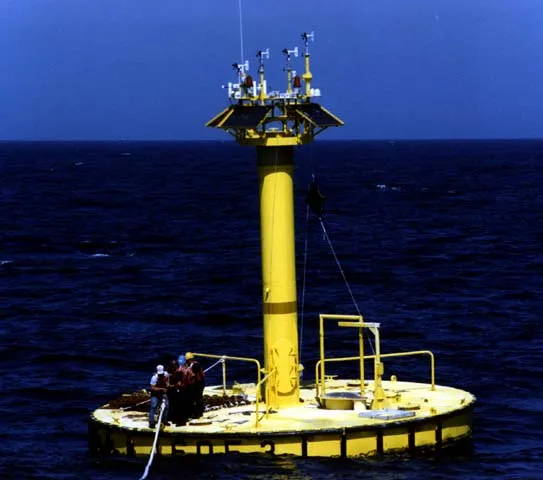
Photo: NOAA, Public domain, via Wikimedia Commons
When a hurricane makes landfall, most of the country sees the radar swirl. The environmental sensing community sees something else: a full-scale, unscheduled stress test of every instrument in the storm's path.
The National Data Buoy Center operates a network of moored platforms along the Gulf and Atlantic coasts. During an average season, a meaningful fraction of those stations will go dark — some temporarily, some permanently. The ones that survive do so because of deliberate engineering choices that read like a checklist for anyone specifying hardware in a marine or coastal environment.
Designing for the Worst Day of the Year
A hurricane-force wind load is only the beginning. Add wave slam, which can deliver impact forces far exceeding anything a static wind calculation predicts. Add salt fog, which infiltrates enclosures and corrodes connectors that would survive decades of ordinary use. Add debris — shipping containers, portions of piers, the occasional boat.
Successful designs share a few traits. Discus-shaped buoy hulls shed water and reduce capsizing risk relative to taller spar designs in shallow coastal water. Instrument enclosures are sealed to IP67 or better, with vented glands that equalize pressure without admitting moisture. Stainless hardware is specified by grade, not by label; 316 stainless resists chloride attack where cheaper 304 grades pit within a single season.
The same logic applies aloft. Dropsondes — tube-shaped instruments released from aircraft into the storm itself — are essentially single-use packages of sensors, a GPS receiver, and a parachute. They are designed to fall at a controlled rate through the eyewall, streaming temperature, humidity, pressure, and wind data until they hit the ocean. They are not designed to be recovered. That constraint shapes everything about them: low cost, minimal mass, and a tolerance for total loss on every mission.
What the Failure Records Show
Post-storm assessments tell a consistent story. Instruments rarely fail because a single sensor element breaks. They fail because of the system around it: a connector wick that draws saltwater into an enclosure, a mooring line chafed through after hours of cycling, a battery compartment compromised by a gasket that hardened in the sun two summers earlier.
Coastal tide gauges and anemometers mounted on fixed structures face their own failure modes. Vibration during sustained high winds loosens fasteners. Wind gusts exceeding the calibrated range of a cup anemometer produce readings that are, at best, approximations — a fact worth remembering when comparing observed gusts across different stations in the same storm.
The lesson is not that field instrumentation is unreliable. It is that reliability is a property of the whole deployment: mounting, sealing, power, communications, and maintenance history, not just the sensor element.
Procurement Lessons From the Eyewall
For researchers and industrial operators specifying equipment, storm-season failures offer practical guidance.
Specify the environment, not the application. "Coastal" is not a specification. Salt-fog exposure per ASTM B117, expected wind loading, and immersion risk are. Vendors who can quote performance against those standards are worth a longer look than vendors who quote a price.
Budget for the mount, not just the meter. A research-grade anemometer on an undersized mast produces research-grade noise. Hardware, grounding, and surge protection deserve a line item comparable to the instrument itself in exposed deployments.
Plan for loss. Dropsondes succeed precisely because their designers accepted that most units would not come back. Networks in hurricane-prone regions should treat some attrition as a design parameter, configuring telemetry so that a lost station degrades gracefully rather than corrupting downstream data pipelines.
Verify survivability claims. A datasheet rating for maximum wind speed says little about sustained exposure combined with salt fog and vibration. Ask for post-storm performance records. Vendors with deployments that survived major landfalls — and can document the data continuity — have earned a specific kind of credibility that no bench test replicates.
The Quiet Payoff
None of this hardware exists for its own sake. Buoy and dropsonde observations feed directly into the hurricane forecast models that determine evacuation zones along the Gulf Coast and the Eastern Seaboard. Every station that survives an extra season, and every dropsonde that transmits through the eyewall, sharpens the intensity forecasts that emergency managers act on.
The instruments that chase storms are, in a real sense, the quietest form of public safety infrastructure in the country. Treating their hardening as a procurement afterthought misreads what is actually at stake when the next named storm forms in the Atlantic.