Below the Spec Sheet: When Megadrought Air Exceeds What Humidity Sensors Were Built For

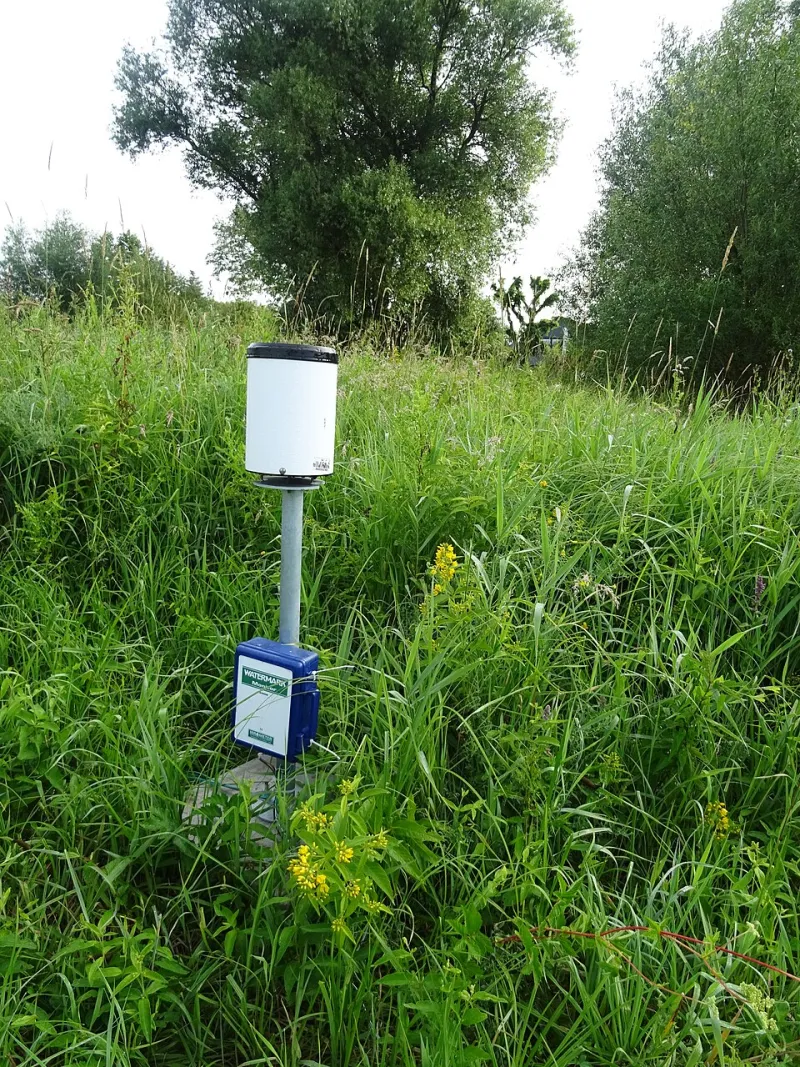
Photo: Vyacheslav Argenberg, CC BY 4.0, via Wikimedia Commons
There is a number buried in most capacitive humidity sensor datasheets that few buyers ever read carefully: the lower bound of the tested operating range. It is typically 0 to 10 percent relative humidity, sometimes stated, often implied. For most of the instrument industry's history, that number was academic. Ambient RH below ten percent is rare, brief, and confined to deserts nobody was monitoring.
It is no longer academic. The megadrought gripping the Southwest has produced sustained episodes of single-digit humidity — in Phoenix, in Las Vegas, in the interior of California — that last not for an afternoon but for weeks. Field researchers in Arizona and New Mexico report sensors that read plausibly on the bench yet fail to recover after prolonged exposure to desiccating air: hysteresis that never closes, response times that stretch from seconds to hours, capacitive elements that age years in a single season.
We think this deserves to be treated as more than a footnote. It is a structural problem in how instruments are specified, warranted, and trusted — and it will get worse before it gets better.
What Drought Does to a Sensor
Capacitive humidity sensors work by measuring water absorbed into a polymer dielectric. The physics of absorption at very low humidity is unkind: the polymer can dry unevenly, and repeated excursions to extreme dryness accelerate the baseline drift that all these sensors exhibit. Resistive and some electrolytic types fare differently, but none are immune.
The field reports coming out of Southwest research groups are consistent. Sensors specified for multi-year deployment are showing calibration shifts at eighteen months. Recovery from saturation events — the monsoon bursts that punctuate desert dryness — is slower than datasheet response curves suggest. And most tellingly, the failures cluster in the exact conditions the test chambers rarely reproduce: sustained extreme dryness punctuated by violent wetting.
The Warranty Paper Trail
Here is where the industry's response has been quieter than the problem warrants. Several manufacturers have revised warranty terms in recent years — some narrowing coverage for deployments in "extreme arid environments," others adding exclusions for RH excursions below specified minima. These revisions are rarely announced with press releases. They appear as clause changes between datasheet revisions, discoverable only by buyers who diff the documents.
We do not think this is necessarily bad faith. Testing protocols and warranty structures were built for a climate envelope that is shifting underneath them. But the asymmetry is real: the manufacturer knows the revised limits, and the buyer often learns them at claim time. A monitoring program in the Colorado River basin deserves to know, before purchase, how its sensor will be treated when the air it breathes falls outside the historical test range.
What Buyers Should Demand
Three asks, in ascending order of difficulty. First, published low-humidity performance data — not just a stated range, but drift and hysteresis characterization at 5 percent RH and below, under thermal cycling. Second, warranty language that names arid-environment exposure explicitly, so exclusions are visible at quotation rather than at claim. Third, honest guidance on maintenance intervals for extreme-dry deployments, because the field evidence suggests the standard recalibration cadence is too slow for these conditions.
Buyers have leverage here. The Southwest hosts some of the densest environmental monitoring investments in the country — water agencies, tribal nations' programs, federal research networks, and utility operators all buying humidity data at scale. Collectively, they can move datasheets the way fleet buyers move automotive specifications.
The Larger Point
Humidity sensors are the quiet workhorses of climate science and water management, and the drought they are being asked to document is, in a real sense, their own stress test. An industry that prides itself on traceability should apply the same standard to its own fine print. If the instruments can't be trusted below ten percent, say so on page one — not in a warranty exclusion nobody reads until the data is already in question.
The next record dry spell is not a hypothetical. The instruments will be there. The question is whether their warranties will mean what buyers think they mean.