When the Instrument Has a Heartbeat: The Strange Precision of Living Sensors
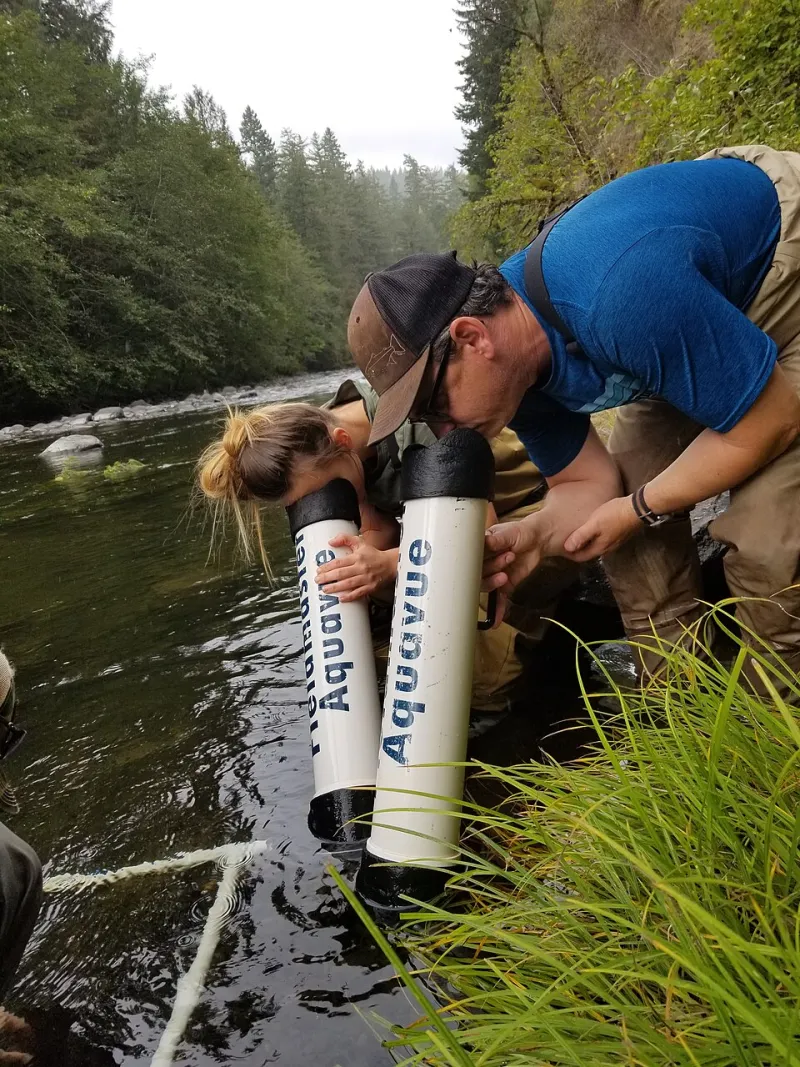
Photo: BLM Oregon & Washington, Public domain, via Wikimedia Commons
The Oldest Sensor in the Room
Before the photodiode and the electrochemical cell, environmental detection belonged to biology. Coal miners carried canaries into the shafts because a small bird's metabolism failed faster than a human's when carbon monoxide crept in. The canary was not an instrument in any formal sense—no calibration certificate, no traceable standard—but it worked, and it worked for decades.
Today, that idea is making an unexpected comeback in laboratories and water utilities across the United States, except the modern versions come with data loggers attached.
Mussels as Flow-Through Monitors
Perhaps the most commercially mature example is the bivalve biomonitor. Freshwater mussels and clams are filter feeders with a well-documented behavior: when water quality degrades, they clamp shut. Wire their shells with electromagnetic coils and you get a binary signal—open or closed—sampled continuously.
Utilities in Germany pioneered these systems decades ago, and the concept has since migrated into American drinking water and industrial discharge monitoring. The appeal is straightforward. A mussel responds to a broad class of toxicants—heavy metals, pesticides, ammonia spikes—without being programmed to detect any specific compound. It is a wide-spectrum tripwire that runs on algae and river water.
The engineering challenges, though, are familiar to anyone who has deployed conventional sensors. Individual mussels vary widely in sensitivity. Some are lazy; some are jumpy. A network of a dozen animals smooths out the outliers, but it also raises the question every instrumentation engineer asks: what exactly is the reference standard here?
Algae That Report on Oxygen
At the opposite end of the size spectrum, photosynthetic organisms are being pressed into service as well. Algal biosensors exploit a simple relationship: photosynthetic efficiency tracks dissolved oxygen and the presence of herbicides. When a toxic compound suppresses photosynthesis, chlorophyll fluorescence shifts in measurable ways. Pair a chamber of algae with an optical detector and you have a living reagent that regenerates itself daily.
Research groups at several US universities have demonstrated algae-based platforms for detecting atrazine runoff in agricultural watersheds—no small matter in the Corn Belt, where herbicide pulses follow spring rains with clockwork regularity. The living sensor approach offers continuous coverage where grab samples and lab chromatography offer snapshots.
The Hive as a Data Acquisition System
Honeybees add a different dimension: mobility. Foragers sample the environment across a radius of several miles, returning with pollen, particulates, and contaminants lodged on their bodies. Researchers have used hive monitoring—tracking colony acoustics, weight, and traffic patterns—as an indirect indicator of local environmental stress, including pesticide exposure and air quality degradation.
A hive behaves less like a point sensor and more like a distributed sampling network with wings. That spatial averaging is valuable, but it also means attribution is difficult. When the signal changes, is it the air, the water, the forage, or the colony itself?
Can You Calibrate a Mussel?
This is the question that separates biological monitoring from a curiosity. Calibration, in the metrological sense, means establishing a traceable relationship between an instrument's output and a known reference. Mussels do not come with certificates. Their response thresholds drift with season, water temperature, reproductive status, and, presumably, mood.
Practitioners have responded the way engineers always do: with statistics and redundancy. Populations instead of individuals. Baseline behavioral profiling over weeks of clean water. Control animals in reference tanks, run in parallel, to separate environmental signal from biological noise. In effect, the calibration is performed on the ensemble, not the organism.
There are real limits. A living sensor cannot be stored on a shelf, powered down, or replaced with an identical unit. It ages. It dies. It has welfare implications that purely electrochemical instruments do not, and facilities deploying bivalve monitors increasingly draft husbandry protocols alongside their QA procedures—a genuinely novel category of documentation for an environmental lab.
Where Biology Fits in the Instrument Rack
The realistic assessment is that living sensors will not replace conventional analytical instruments. They will complement them. A mussel array can watch a water intake around the clock and flag an anomaly; a mass spectrometer then identifies exactly what the anomaly was. The biology provides breadth and persistence; the machine chemistry provides specificity and legal defensibility.
For US utilities, watershed managers, and industrial facilities weighing monitoring budgets, the calculus is becoming concrete. Living sensors occupy a niche that electronic instruments still fill poorly: cheap, continuous, broad-spectrum surveillance of complex matrices. The canary never needed to identify the gas. It only needed to notice.
A century after the last canary left the coal mine, the principle survives—now with fiber optics, statistical baselines, and, at last, a calibration file.