The Standing Report: What Trees Tell Us When We Wire Them for Sound
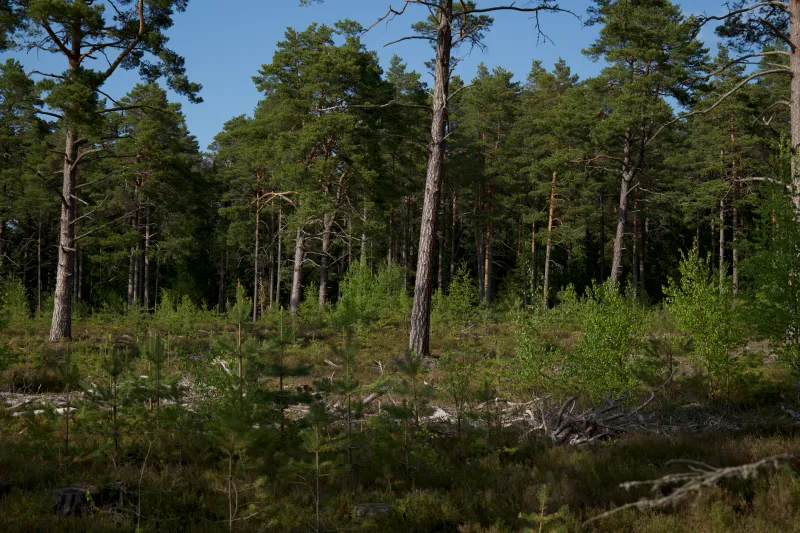
A mature ponderosa pine does not file reports. It does not raise an alarm when its needles begin to desiccate, or when bark beetles begin probing its cambium. For most of the history of American forestry, the tree's condition was assessed the way it always has been: someone walked in, looked up, and made a judgment call.
That is beginning to change. Across California, Oregon, Colorado, and Arizona, a quiet build-out of in-forest instrumentation is giving land managers something they have never had at scale — a continuous, quantitative account of tree health, delivered from inside the stand rather than inferred from a helicopter survey.
The Instrument Stack in the Understory
The typical forest mesh node is a modest assembly. Soil moisture probes at multiple depths track the water actually available to roots, not just what fell from the sky. Dendrometers — bands that measure trunk expansion and contraction at micron resolution — reveal whether a tree is growing or merely surviving. Sap-flow sensors, heated needles clamped into the xylem, report how hard the tree is working to move water on any given afternoon.
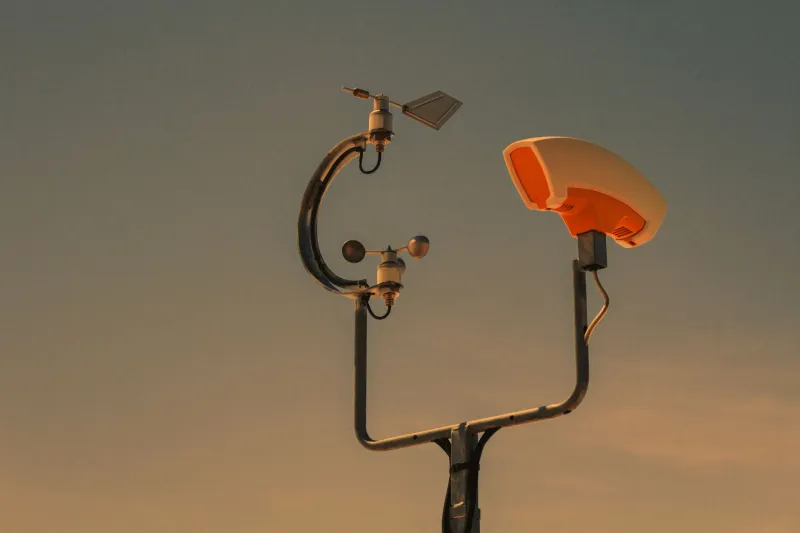
Tie these together with low-power radio — LoRaWAN has become the de facto choice for its range and miserly power draw — and a research stand becomes a live telemetry feed. Solar panels and lithium packs keep nodes running through winters that would kill a laptop in an hour.
What emerges is not a single number but a physiological signature. A healthy forest breathes in a recognizable rhythm: trunk swelling at night, sap flow peaking mid-morning, soil moisture recharging with each storm. Drought stress shows up as a flattening of that rhythm weeks before foliage discolors. Beetle pressure can surface in reduced flow on individual stems long before needle fade makes the casualty visible from the air.
Early Warning, Measured in Weeks
The practical value lies in that lead time. In California's Sierra Nevada, the 2012–2016 drought killed more than a hundred million trees, many of them detected only after they had turned rust-red and become fuel. Managers reviewing dense instrument data from experimental plots say the physiological signs of severe stress — collapsing sap flow, sustained trunk shrinkage — appeared well ahead of the aerial detection that eventually mapped the mortality.
The same logic applies to fire risk. Live fuel moisture, traditionally sampled by hand-clipping shrubs at designated stations on a weekly or biweekly schedule, can now be approximated continuously from soil and plant sensors across a mesh. Fuel moisture is among the most consequential inputs in fire behavior modeling, and the difference between a weekly estimate and an hourly reading matters during a wind event.
Several western universities and the USDA Forest Service's experimental forests have been the proving grounds. Networks like those at the Sierra Nevada sites and the Critical Zone Observatories have demonstrated that the data is reliable. The harder question is what happens next.
The Economics of a Silent Asset
A forest does not invoice anyone. Unlike an orchard, where a soil probe protects a crop with a market price, a national forest produces watershed, habitat, carbon storage, and scenery — none of which generate a revenue line to justify instrumentation.
The result is an awkward funding patchwork. Research grants install the nodes. When the grants lapse, the meshes go dark — a pattern familiar to anyone who has followed long-term environmental monitoring. Some states have begun folding sensor networks into drought early-warning programs and wildfire mitigation budgets, treating the hardware as hazard-reduction infrastructure rather than research equipment. Others are exploring cost-sharing with water utilities, whose intakes depend on forested headwaters.
Per-node costs have fallen enough to change the arithmetic. A basic soil-and-dendrometer node that would have cost five figures a decade ago can now be assembled for a few hundred dollars, though installation, permitting in wilderness-adjacent terrain, and seasonal maintenance still dominate the budget. The honest accounting is that instrumentation is cheap relative to the labor of keeping it alive in bear country at 6,000 feet.
From Research Plot to Operations
The gap between demonstration and operations is institutional, not technical. Land managers say what they need is not more sensors but translation: dashboards that convert sap-flow anomalies into a recommended action, and procurement channels that let a district ranger buy a mesh the way they buy radios.
Some of that translation is arriving. Commercial platforms now package forest telemetry alongside weather and fuel data, and several state forestry agencies are piloting subscriptions rather than one-off grants. The model resembles what precision agriculture went through twenty years ago — a slow migration from experiment to standard practice, driven by demonstrated savings.
The trees, of course, have been reporting all along. The rings record every drought; the needles record every beetle. The difference now is that the report arrives in time to matter.