When the Worm Turns and the Probe Disagrees: Three Farms at the Fault Line of Weather Folklore
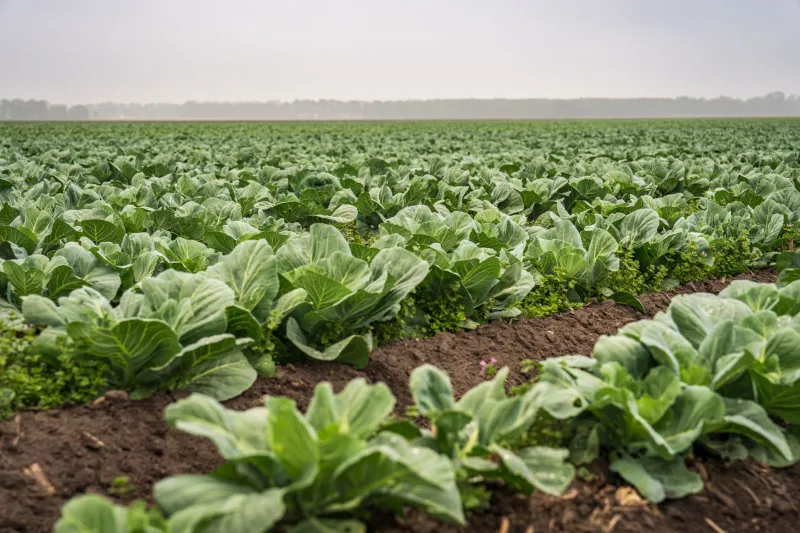
For most of American agricultural history, the most sophisticated environmental monitoring network in the country was memory. Farmers watched woolly bear caterpillars, noted the thickness of corn husks, and kept a grandmother's rule about planting when oak leaves reached squirrel-ear size. That knowledge was calibrated over generations against specific fields — the low corner that flooded, the south slope that warmed first.
Now a different network is going into the ground. Capacitance soil moisture probes, leaf wetness sensors, and canopy temperature arrays are being installed at a pace that has made on-farm telemetry one of the fastest-growing segments of the environmental sensing market. The question that follows is not whether the instruments work. It is what happens in the years when both systems are running — and they disagree.
The Holdout: Phenology Has a Perfect Record (Until It Doesn't)
Outside Brookings, South Dakota, a third-generation operation we'll call the Hendricksen farm — the family asked that details be generalized — remains deliberately instrument-free. The reasoning is consistent and, in places, uncomfortably persuasive.
"A probe tells you what the soil is doing today," the eldest Hendricksen says. "The caterpillar told my grandfather what winter was going to do. Those aren't the same question."
There is a kernel of scientific legitimacy here. Phenological indicators — the timing of biological events — do integrate long-range signals in ways a point measurement cannot. But they integrate them crudely, and the literature on woolly bear accuracy is, charitably, mixed. What folk knowledge genuinely captures is something the sensor rack struggles with: field-specific history. The Hendricksens know which quarter section dries out two weeks early. That is data. It just was never written down as data.
The Convert: Yield Maps Don't Argue
Ninety minutes south, a younger operation finished its transition to a full in-ground network three seasons ago. Moisture probes at four depths, a private weather station, and a dashboard the whole family checks before breakfast.
The conversion story is common: a drought year where irrigation decisions based on feel cost real money. "The almanac said wet spring, hard winter," the operator told us. "The probes said the subsoil was empty by June 1. The probes were right."
What convinced the family wasn't a single dramatic save — it was the irrigation scheduling alone. Measured moisture at the twelve-inch depth replaced the traditional practice of digging a handful of soil and squeezing it. The savings in pumping costs paid for the network in under two years, which is the sentence that ends most conversion stories.
The Transition Farm: Two Truths, One Field
The most instructive case is the farm in the middle — the one we might call the fault line. A central Nebraska operation running both systems simultaneously, partly out of caution and partly because the father and son who run it trust different sources.
The disagreements are the interesting part. Folk indicators called for an early planting window one recent spring; soil temperature sensors at seed depth said wait nine days. The son followed the sensors. The stand was uneven anyway — a cold snap the sensors registered but the folklore, tuned to air temperature signals, had discounted.
Other times the relationship inverts. A local folk rule about hail seasons, built on decades of storm observations, flagged a risk pattern the farm's rain gauge network had no way to see. The lesson both generations now accept: the two systems measure different things, and neither is redundant.
What the Transition Years Teach the Sensing Industry
For the monitoring industry, these transition farms are the proving ground, and the takeaways are consistent across every operation we spoke with:
- Calibration beats replacement. Networks that encode folk knowledge as baseline expectations — expected dry-down dates, typical frost windows — earn trust faster than blank dashboards.
- Point measurements need context. A single probe can be right about its cubic foot of soil and wrong about the field. Denser arrays narrow that gap.
- Trust is a data handoff problem. The farms that succeed treat grandpa's rules as legacy datasets to be validated, not superstition to be discarded.
The almanac era is ending not because the old knowledge was wrong, but because it was unscalable and unshareable — locked in individual heads. Sensors are, in a sense, an attempt to write it all down. The farms doing this best are the ones that treat the transition as a merger of two monitoring networks, not a hostile takeover.